
A buyer who was gazumped last year, told yesterday’s Sunday Times readers that he was “legally mugged for £25,000 – by an estate agent”.
He is also highly critical of the Property Ombudsman, suggesting that his £200 award was paltry.
However, painting a very different picture of what went wrong, ombudsman Christopher Hamer yesterday told Eye that there had been a delay in progressing the sale and “the new offer arose only because the complainant was unable to finalise his finances”.
Hamer also said that he would never have said he was supportive of gazumping. The agent concerned also strongly defended its stance, saying it had acted in the interests of its client.
Writing in Home, the Sunday Times property supplement, Bruce Millar – who also wrote about his experience of gazumping in April last year – yesterday complained that he was buying through Marsh & Parsons when his offer was accepted.
The agent, says Millar, “assured me” the house would be taken off the market. But he says, Marsh & Parsons “refused to remove the property details from online listings”. He says he was told it was company policy and that it did not count as “active marketing”.
Millar goes on: “In the digital age, however, such a listing is nine-tenths of marketing.”
His worst fears were realised. Days before the scheduled exchange, Marsh & Parsons told Millar that another buyer had offered £25,000 more.
Millar, who spent £1,500 on abortive legal fees and then spent an unplanned six extra months in rental accommodation, complained to the Property Ombudsman.
He says TPO upheld his complaint, apparently criticising the agents for not amending the website listing to “under offer”.
However, the ombudsman did say that Marsh & Parsons was not to blame for its client deciding to accept the higher offer.
TPO ordered £200 in compensation, to which Millar retorts furiously: “Yes, just £200, the amount I imagine a smart London agent probably spend on flowers for the office every week.”
As for Marsh & Parsons not being to blame for its client’s decision to take the higher offer – “Apparently that fault lies with the (£25,000 richer) seller. Yet another slap in the face”.
Yesterday, property ombudsman Christopher Hamer told Eye: “I did meet the complainant in this case because he said he was going to do something for the Sunday Times.
“I wanted to explain to him that I cannot penalise agents. That is not what an Ombudsman or a redress scheme does, and my award of compensation reflected my assessment of the aggravation caused to the complainant directly as a result of the agent’s shortcomings.
“The delay in progressing the sale and the new offer arose only because the complainant was unable to finalise his finances.”
Hamer also said that he supported the complaint, because Marsh & Parsons should have alerted the complainant to the seller’s anxiety that the sale was not progressing at speed.
Hamer said: “If I remember rightly, the new offer came from someone local who had seen the house for sale and made an offer unsolicited by the agent who rightly referred it on to the seller.
“That seller instructed Marsh & Parsons not to go back to the complainant – they were acting on client instruction.
“The complainant could not raise the money over an extended timescale. When I spoke to him he was blaming the bank so perhaps he should complain to them.
“Interestingly, when I spoke to him he told me he had now bought a house which cost half the one he was trying to buy through M&P so was there perhaps an issue with finances.
“As regards my award, I can only require Marsh & Parsons to pay compensation for what is their responsibility, not to make them pay because he lost the house he wanted when there is no certainty he would get it.”
Hamer added: “I supported the complaint in that Marsh & Parsons should have alerted him to the seller’s anxiety that the sake was not progressing at speed.”
Peter Rollings, chief executive of Marsh & Parsons, said this morning: “In my opinion, this is a classic example of an estate agent doing what we are supposed to do – protecting our client.
“This particular transaction took an age to get finance arranged and whilst we do advise prospective viewers that an offer is agreed, we do not change the status on the website.
“This enables us to gather a list of prospective buyers should the transaction fall through, rather than simply starting to market again and obviously putting our client at a disadvantage.
“In this particular instance, a buyer who had seen it some two months previously made an offer in excess of the asking price, which we were obviously duty-bound to put to our client.
“Our client had, by this time, lost faith in the original buyer and therefore instructed us to accept the increased offer and to proceed, which we did.
“We were apologetic to the existing purchaser, however I’m not surprised that he failed to understand the situation. Disappointed buyers seldom do.
“Having spoken to him at length I was disappointed in the tone of the article and pleased that the ombudsman put the record straight in your piece. However, with due respect, I’m not sure as many people read Property Eye as they do the Sunday Times!”
* The article appeared as part of a spread which put the boot into estate agents.
Of course, editorial should never be influenced by advertising, and certainly yesterday’s spread made it clear that this is entirely the case.
However, agent advertisers might feel it did look a bit like the gratuitous biting of the hand that feeds it.
Under the headline ‘Professional fouls’, the sub-headline asked if estate agents “deserve their slippery reputation” and said that what followed was “a guide to their dirtiest tricks”.
The piece did acknowledge that “Britain’s agents offer relatively good value” charging sellers “1.5% to 2%”, but said that “some agents cannot resist living down to their image”.
Among the ten “dirty” tricks were overvaluing, touting, dodgy property details, non-existent buyers, fake testimonials, and open houses which apparently whip buyers into a frenzy and makes them offer more than the asking price.
Of course, no one likes rogue estate agents – agents least of all, because of the reputational damage to the whole industry.
But Eye suspects that if we were to pitch an article about good estate agents, what you actually do, the hours you work, and why you are worth every penny, we would get nowhere fast.
Part of the article when it went online is reproduced below.







Comments (20)
Oh! the delicious irony…
Sally Jones above states “Once again an article written by someone who has no idea about the legalities of selling a house (as an agent) but hey what does that matter if it makes good reading!!!!”
Yes, Sally – someone with no idea whatsoever – who just happens to also be THE EDITOR of the rival news website to EYE!
Ouch! Above the waistband please! (It wasn’t below the belt but PIE won’t let me do succinct single word post so I had to pad it out a bit)
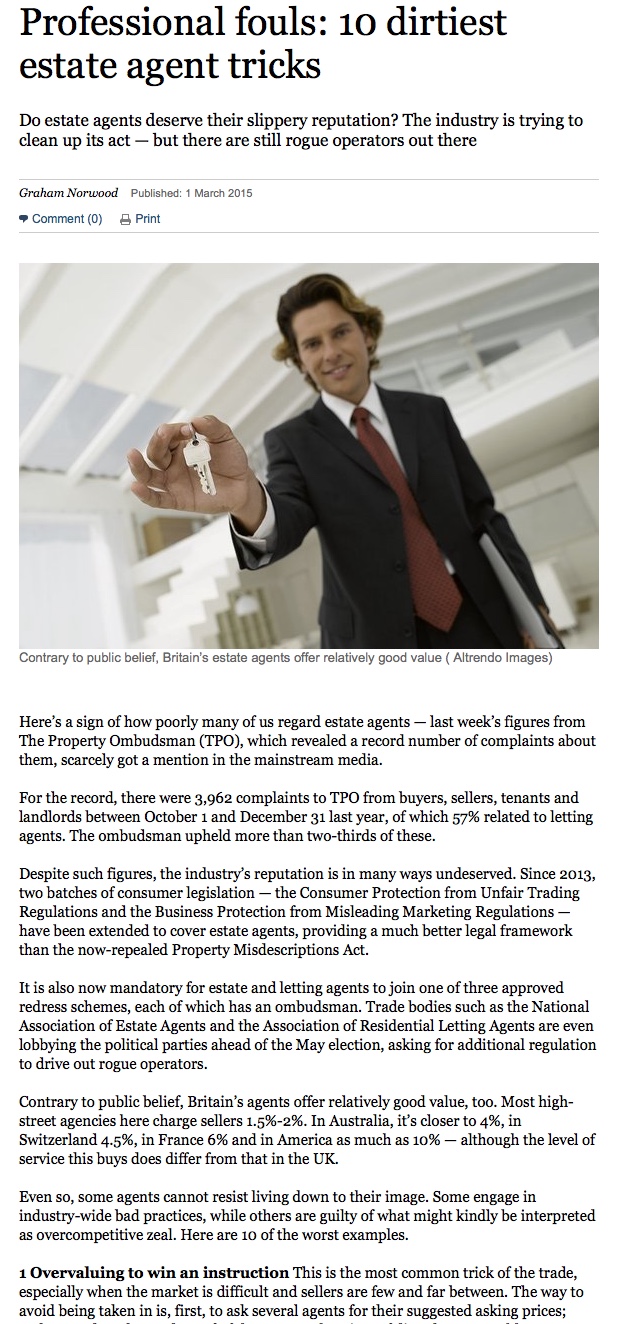
I think the public, on the whole, think that High St Agency is far more professional in every way compared with the past. You only have to look at the picture of “the agent” in the article to see how old hat this type of sniping is. I would date the hairstyle and clothing to the late 80’s early 90’s.
and is that paper in his other hand…….. I thought everyone uses one of those iPaperNotePadSheetGadgetty kind of thing now!
Strange you mention that Wilko,
I was speaking with a friend at the weekend (he is a fellow agent) and we both think in the last 10 years the perception of the “Estate Agent” has improved.
I think the reality is that it has improved, such a competitive industry now, you need a good reputation and you need to be able to offer a service. Vendors are much more demanding and are more clued up which has forced our industry in the whole to improve.
There are still poor agents out there (as with any industry) but the vast majority of agents i know and come across and much better than the “old school” agents of the 80 & 90’s most of them have thankfully left the industry or in a corporate chain with a reputation of being a journeyman!
Attack the estate agent again then!
What would they prefer? Not to put the offer forward? – I can just see the headlines then.
‘Unscrupulous estate agent, acting outside the law defrauds seller of £25,000’
There are lots of great headlines and stories to be had Smile. My favourite one right now.
HMRC tax evasion scandal makes HSBC look like Yeoman of the Guard
Incompetent HMRC department admitted to not having a clue how many landlords are renting out Property and dismissed a solution to find out as “not of interest”
Danny Alexander claimed to be embarrassed at the jailing of the whole of HMRC and denied it was a sneaky, but very popular piece of electioneering ahead of May’s election.
Robert, your statement is a tad inaccurate on two counts.
During 2014 HMRC wrote to Lettings agents for details of all landlords that they had let property for.
In addition they are getting information from deposit schemes.
So unless you do not take a deposit and never use an agent, you will show on their radar eventually. Sadly the rogue landlords that everyone, myself included, complains about will be the ones that avoid detection. They are unlikely to use an agent nor protect any deposit taken.
It is not inaccurate at all. HMRC have for a very long time the ability to Section 19 each agent, last time I checked they were struggling with archaic systems to cope with a fraction of the data from 7 years previous. (The limitation for tax is longer than 6 years so they have time to catch up)
Some 200,000 (est) landlords don’t use agents. HMRC received about 500,000 SA105 returns but do not know how many they should have received.
Please bear in mind my systems transact now about £21,600,000,000 rent annually this might be my specialist subject to the point where Officials from HRMS have sat in my parlour discussing the inadequacies of the system. A letter on Cream Whitehall Velum says it isn’t me who is wrong on this!
Once again an article written by someone who has no idea about the legalities of selling a house (as an agent) but hey what does that matter if it makes good reading!!!! The agent had a legal obligation to put the other offer forward but somehow that’s been swept under the carpet!!! I also agree with Robert May – it is unacceptable that the number of complaints was not put into context. Good grief doesn’t anyone at the newspaper check these articles prior to them being published!
The journalist Bruce Millar wrote the same story last April. It’s a sort of harbinger of Spring. Let’s hope Graham Norwood ensured he got a repeat fee.
An advanced Google search shows this same (ish) story being repeated and repeated on EAT.
Not putting the numbers in context and leaving out that not all XXX complaints are upheld is all part of TPO Ltd’s marketing and lobbying strategy.
Funny three x’s fall foul of the filth filter! xxx
To perform an advanced Google serach include the words TPO and Complaints, along with the word Site: followed by the URL of the site you want to search (http://etcetcetc.co.uk) that search for this propagnada comes up over 11oo times on the place I should not have mentioned. Tha be Dragons!
“the new offer came from someone local who had seen the house for sale and made an offer unsolicited by the agent who rightly referred it on to the seller.”
An agent complying with the Law is not a solid ground for complaint. Perhaps M&P did it for the extra £500 commission and the neg for his £50 before tax? Perhaps not. With M&P’s average fee level the only motive was to comply with the Law. Well done to His Royal Ombudsmaness for defending & clarifying the situation and in doing do, explaining why gazumping is seldom the fault of an agent.
This guy could put his money (which he doesn’t seem to have) where his mouth is and sign an undertaking now stating that when he comes to sell he’ll instruct his estate agent not to put forward any higher offer they may receive after he’s agreed a sale.
Let’s see if HE would be happy to throw that money away.
Also did the Sunday Times mention that the estate agent has a legal obligation to forward any offers received prior to exchange of contracts? I suspect not, they’ve never been too worried about the facts getting in the way of a good story.
” the estate agent has a legal obligation to forward any offers received prior to exchange of contracts? ” Where can I locate this fact? My estate agent convinced me to lower price by £50K after I had an extremely stressful family event, and immediately got an offer in a day. Now the buyer “Under Offer” – whose chain is four additional transactions – has instructed my agent NOT to show MY property. My agent has agreed without my permission. I am at a loss and I am selling a family home of fifty years but I feel cheated. Thanks in advance if you choose to reply, Millstreet
3962 complaints to TPO? wow out of 840,000 sales and 4,000,000 ish tenancies. It is a disgrace!!!! It is a disgrace that whoever wrote the article didn’t have the wit or the will to put the 0.082% complaint ratio in the context of the job being done!
Idiots- both those supplying the information and those publishing it!
@Robert May…………..with a customer each side of every transaction its 1,680,000 people for sales and 8,000,000 lettings so a total of 9,680,000 so the % of complaints is 0.04% – ill wait for the kicking I may receive for attempting maths as im sure im worng- Jonnie
Your maths is good Jonnie!
but when manipulating the output you have forgotten to Shelter or Journalist or Generation Rent or Which adjust the data. Accordingly the shocking news here is that adjusted across the whole population 13.24 millon people had cause to complain to the ombudsman, that is over 1 in5 Britains mugged by Estate and Letting Agents
Don’t laugh they actually do extrapolate data that way when lobbying for legislation.